
Popular Posts
-
 I recently talked to Teena Tan of Sabrina Clothing and I also got to try a few of her pieces. You may read the feature on When in Manila...
 -
In retrospect: They're finishing each other's sentences. They're filling the gaps in each other's hands. They're both th...
-
Murdered toes with calloused brows Calloused toes with murdered brows Threatening dildos amidst Hypertonic coitus A conniving flapper agains...
-
She slithers abreast of him, blissfully inserts her warm-felt thighs in between his, and bats her eyes. Without her eyeglasses, her vision i...
-
1 I like taking baths when it's past midnight. Everyone else is asleep. And (I could only / only I could) hear the trickling of the b...
-
"a catatonic catwoman, a catastrophe!" As far back as I can remember, I wasn't really fascinated with cats as a kid. But ...
-
They are dressed like parody today: her glittered nails in turquoise and white, his ashen shirt in red and plaid. Her lashes bats for his, h...
-
This blog is under renovation. Click here to view updates from basterda .
-
Her guts are trussed and she smells just like the afternoon's humidity. She only had 5 hours of sleep and as usual, glum circles infest ...
-
His breathing next to hers, tantamount to her completeness. She sighs in disbelief: forever after is theirs to devour. She's lost for wo...

Showing posts with label feature shoot. Show all posts
Showing posts with label feature shoot. Show all posts
Evocative ‘Souvenir’ Photos Arranged by Mood and the Color Blue
* originally published on Feature Shoot *
"I take pictures like a tourist, mostly to create nice images and souvenirs, but in a way, I feel that photography is a weak way to help you to remember. It creates images that become stronger than your souvenirs or memories and consumes them. With time, I find myself trying to recreate the memories starting from the picture, instead of including the picture inside the true memory." —Leo Berne

Paris-based photographer Leo Berne has an interesting theory about photographs: they are the simplest way to make a memory, yet they can’t really be trusted. Betty Blue is a series shot in his signature souvenir-making style but compiled together based on mood and color, essentially making them random in terms of place and time while disconnecting them from actual memories.
Berne works as a promo director for a collective called MEGAFORCE, and is represented by Clast.
* see more images *
"I take pictures like a tourist, mostly to create nice images and souvenirs, but in a way, I feel that photography is a weak way to help you to remember. It creates images that become stronger than your souvenirs or memories and consumes them. With time, I find myself trying to recreate the memories starting from the picture, instead of including the picture inside the true memory." —Leo Berne
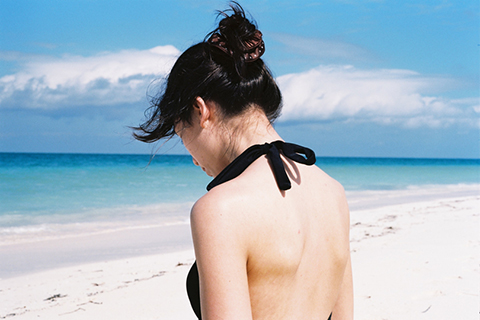
Paris-based photographer Leo Berne has an interesting theory about photographs: they are the simplest way to make a memory, yet they can’t really be trusted. Betty Blue is a series shot in his signature souvenir-making style but compiled together based on mood and color, essentially making them random in terms of place and time while disconnecting them from actual memories.
Berne works as a promo director for a collective called MEGAFORCE, and is represented by Clast.
* see more images *

Paulina Otylie Surys’ Fashionable Portrayals of Pulchritude
* originally published on Feature Shoot *
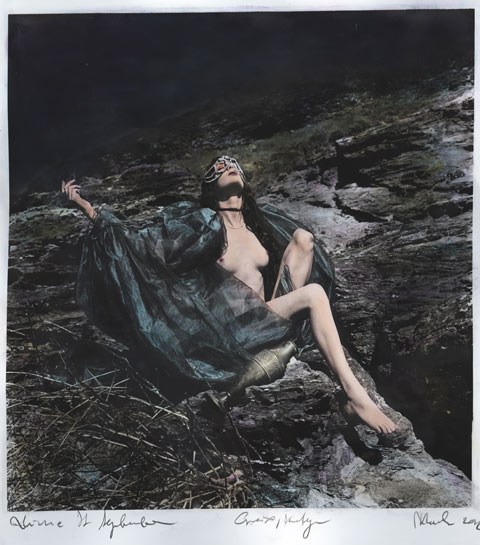
Paulina Otylie Surys is a Polish London-based fine art and fashion photographer who combines phantasm of film photography and the beauty of painting to create exquisite images. Her first book, a monographic album, was recently released by Paulsen Editions.
 When did you begin taking pictures? What was your first camera?
‘Polaroid Landcamera 210 was my first camera. I bought it in 2003 and I did a series of hand-tinted peel apart Polaroid landscapes for my screen print project. Afterwards, I did not experiment with photography until I bought my first Lubitel. This is when the adventure started; I had finally found my medium, and I realized that it was exactly what I had been looking for. I have never returned to painting but I do feel that I have successfully blended it with photography.’
Describe your style in photography. What are your usual subjects and themes?
‘I take photographs of things which are often unnoticed by the naked eye, or shoot subjects in a way that they are not commonly seen. Once photographed, these details will be understood in a, possibly infinite, variety of ways, depending on the viewer. They will create the final piece in their own minds. Mythological symbolism can be a tool for controlling such subjective viewing.
‘I am aware that my photography may seem weird, perhaps even aggressive to the viewer. I can be rather domineering when shooting in order to provoke emotions in the subject, to get to know them better.’
 Amongst your numerous film photographs, which is your favourite?
‘I think the most exciting projects are always those which are yet to be done, existing only in my sketchbook as a brief. I am always very excited about them, especially if they are connected with my personal interests. For instance, recently I have been exploring a fusion of photography, religion and science and have also produced a project on exploring the concept of beauty which will result in a show and my second book in 2013.’
Who or what influences your photographic style?
‘I appreciate good photography in any style and using any technique. However, among my early influences I would name Margaret Julia Cameron, Nadar, Joel Peter Witkin, Jan Saudek, Paolo Roversi, and Irina Ionesco. Most of my influences are derived from classical paintings, literature, history, religion and mythology. Sometimes though, it can be simply a location or person that triggers the idea for the shoot.’
 What makes analogue photography more special?
‘I personally find analogue photography extremely creative, it is just fascinating; the feel of it, the smell and touch. It’s the magic of chemical reactions, of recording objects and people in a unique way. A photographer cannot avoid giving each of their images an individual touch that no other can truly emulate.
That is not to say I am against digital photography, I have worked with this medium in the past; I just never enjoyed it as much as analogue. Digital images can be so perfect and glossy (especially if combined with a high key flash light) that they can lose some of the unnamable essence that appeals to me so much. I really enjoy the texture of hand printed photographs. The grain which, depending on the treatment, can be smooth or very big, is what gives the works their individual characters and strengths.
‘I work in a black and white and colour darkroom, and am experimenting with other alternative processes such as wet plate collodion (hand coloured photographs on glass and metal).’
 What words of wisdom do you have for young/emerging photographers?
‘Do not be afraid of making mistakes and works you consider failures, the best works always results from experiments. Sometimes it’s hard to continue when you fail or have people trying to put you down, but you learn to get over it; it only makes you stronger and better. The photographer’s personality and mental strength is as important as their creativity.’
Aside from your website, do you have other creative online, offline projects? If none, what creative pursuits could you explore?
‘I have just had my first book published by Paulsen Editions and the launch is in Paris during Paris Photo from November 14-17, 2012. There will be also a launch in London at the end of November.
‘I am also preparing for my solo exhibition (February 2013 in Kensington & Chelsea) and have just finished the brief for my second book.’
Paulina Otylie Surys is a Polish London-based fine art and fashion photographer who combines phantasm of film photography and the beauty of painting to create exquisite images. Her first book, a monographic album, was recently released by Paulsen Editions.
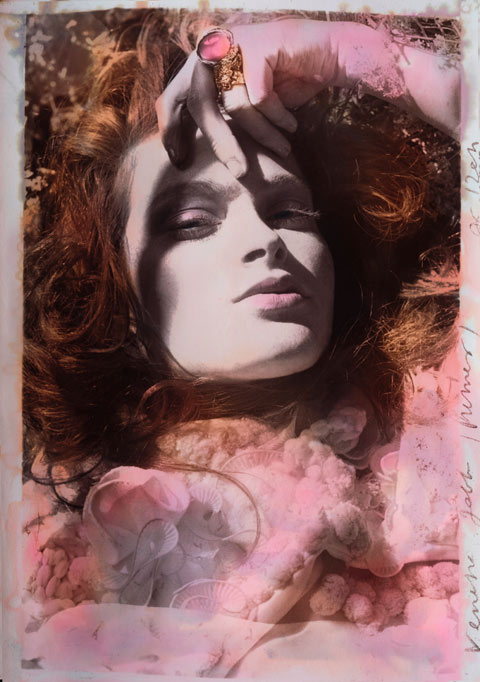
‘Polaroid Landcamera 210 was my first camera. I bought it in 2003 and I did a series of hand-tinted peel apart Polaroid landscapes for my screen print project. Afterwards, I did not experiment with photography until I bought my first Lubitel. This is when the adventure started; I had finally found my medium, and I realized that it was exactly what I had been looking for. I have never returned to painting but I do feel that I have successfully blended it with photography.’
Describe your style in photography. What are your usual subjects and themes?
‘I take photographs of things which are often unnoticed by the naked eye, or shoot subjects in a way that they are not commonly seen. Once photographed, these details will be understood in a, possibly infinite, variety of ways, depending on the viewer. They will create the final piece in their own minds. Mythological symbolism can be a tool for controlling such subjective viewing.
‘I am aware that my photography may seem weird, perhaps even aggressive to the viewer. I can be rather domineering when shooting in order to provoke emotions in the subject, to get to know them better.’
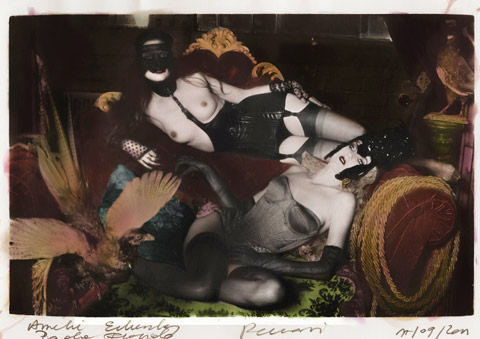
‘I think the most exciting projects are always those which are yet to be done, existing only in my sketchbook as a brief. I am always very excited about them, especially if they are connected with my personal interests. For instance, recently I have been exploring a fusion of photography, religion and science and have also produced a project on exploring the concept of beauty which will result in a show and my second book in 2013.’
Who or what influences your photographic style?
‘I appreciate good photography in any style and using any technique. However, among my early influences I would name Margaret Julia Cameron, Nadar, Joel Peter Witkin, Jan Saudek, Paolo Roversi, and Irina Ionesco. Most of my influences are derived from classical paintings, literature, history, religion and mythology. Sometimes though, it can be simply a location or person that triggers the idea for the shoot.’
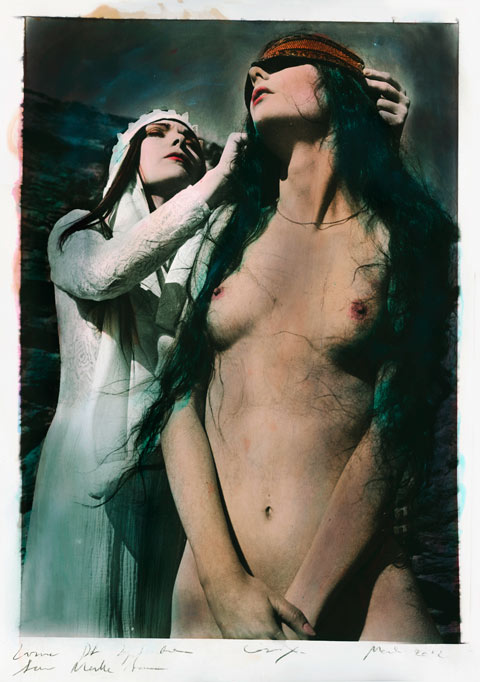
‘I personally find analogue photography extremely creative, it is just fascinating; the feel of it, the smell and touch. It’s the magic of chemical reactions, of recording objects and people in a unique way. A photographer cannot avoid giving each of their images an individual touch that no other can truly emulate.
That is not to say I am against digital photography, I have worked with this medium in the past; I just never enjoyed it as much as analogue. Digital images can be so perfect and glossy (especially if combined with a high key flash light) that they can lose some of the unnamable essence that appeals to me so much. I really enjoy the texture of hand printed photographs. The grain which, depending on the treatment, can be smooth or very big, is what gives the works their individual characters and strengths.
‘I work in a black and white and colour darkroom, and am experimenting with other alternative processes such as wet plate collodion (hand coloured photographs on glass and metal).’
‘Do not be afraid of making mistakes and works you consider failures, the best works always results from experiments. Sometimes it’s hard to continue when you fail or have people trying to put you down, but you learn to get over it; it only makes you stronger and better. The photographer’s personality and mental strength is as important as their creativity.’
Aside from your website, do you have other creative online, offline projects? If none, what creative pursuits could you explore?
‘I have just had my first book published by Paulsen Editions and the launch is in Paris during Paris Photo from November 14-17, 2012. There will be also a launch in London at the end of November.
‘I am also preparing for my solo exhibition (February 2013 in Kensington & Chelsea) and have just finished the brief for my second book.’
The Spellbinding Fashion Photographs of Ellen Rogers
* originally published on Feature Shoot *
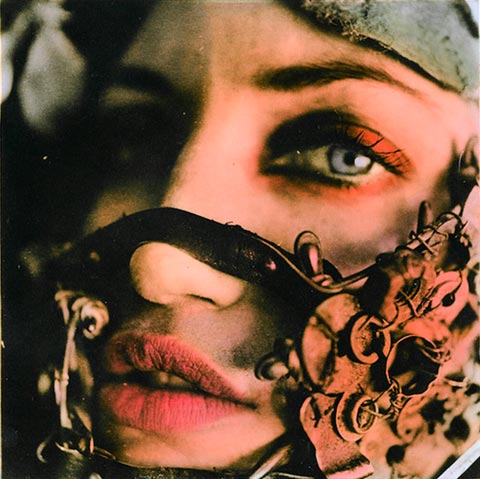
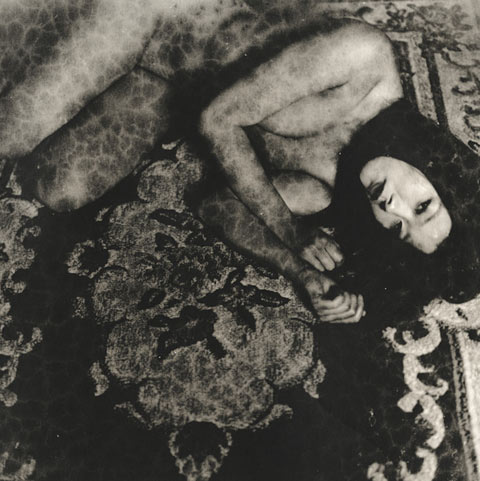
Ellen Rogers is a fashion photographer and filmmaker from London. Aberrant Necropolis, a two-year collection of her photographs, is her first book. We interviewed her about her inspirations and collaborations with partner, Prizme.
 Your style exudes with elegance, macabre, and style. How do you come up with new concepts and ideas for your next shoot?
‘My boyfriend Prizme and I are like sponges for information, constantly thirsty. We are hopelessly looking for something abstract, vaporous, mostly emotive, and unfinished.
‘In my journey, things have lodged themselves in me, acting like thorns, I pull them out, and I examine them. These thorns are the next ideas, they are usually tantalizing to us in some way… something promising.’
All of your muses are haunting in a lovely way. What certain characteristics do you look for in a muse?
‘I think a muse for me should have a certain attitude. She is willing but chic, not annoying at all. Not too needy, aloof but intelligent, and a little seductive. I’m a cat person, you see.’
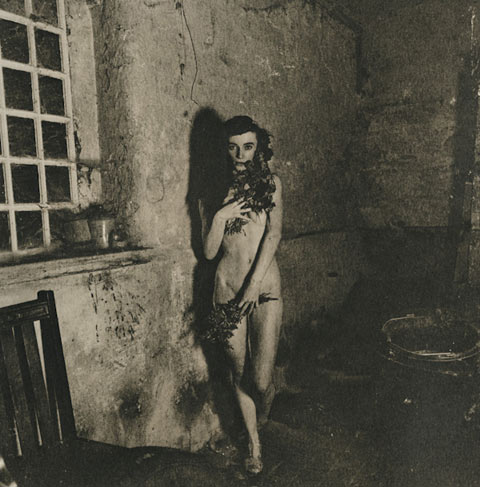
 Your black and white photographs, even if they’re not enamored with colours, still radiate beauty and timelessness. How does your monochrome photographs differ from the colored ones? When do you know if you want to use color or not?
‘That’s very kind of you to say. I don’t intend to process why I pick certain images anymore, those images just jump out at me now. I know it probably has a lot to do with texture (whether or not they are worth colouring). I can mostly envisage them before they are finished so I know what level of boldness to look for or not.’
You are an advocate of analogue photography. Please share with us your fascination with film.
‘I’m not great with words and trying to be succinct is my short fall but to try, on an abstract level, I like to gain and lose control all at once. I like to know enough about the medium to control it and know enough too to let it talk and make its own mistakes, mistakes that are organic and earthly. I would imagine that to recreate these purposefully, is a flat outcome. However, I don’t know as I have never really tried.’
 You always have projects with Prizme, your boyfriend. How is it like to work with someone whom you adore and, at the same time, share similar eccentricity with?
‘I like that you chose the word eccentricity. I have not ever met anyone like Prizme (Tobias) or am I ever likely to meet anyone like him. I suppose to sound corny: we are literally other halves to each other, so working together is as natural as being together.
‘We are both anti-socials at best. We met through mutual friends who struggled to get either of us out of our houses to meet other people. So when we met one another it felt like at last we had met someone who understood entirely, our drive and blind determination, to be removed from distractions and work solely on artwork at all costs as though our lives depended on it. It can be intense but it’s imperative for our sanity.’
What (or who) inspires and influences you?
‘Prizme, Bataille, Jung, Rimbald, Maxine (current muse) and many more.’
 What projects of yours should we look forward to?
‘I will be making more films, certainly. I have something very dear to my heart that I wish to work on with a very special muse. Film is something very difficult for me so its challenge draws me closer every day.
‘I also have a hugely exciting and ambitious project coming soon with Prizme. He will be taking a leading role and I will be his director as it were. I think it will be on kickstarter at the end of the year.’
Ellen Rogers is a fashion photographer and filmmaker from London. Aberrant Necropolis, a two-year collection of her photographs, is her first book. We interviewed her about her inspirations and collaborations with partner, Prizme.
‘My boyfriend Prizme and I are like sponges for information, constantly thirsty. We are hopelessly looking for something abstract, vaporous, mostly emotive, and unfinished.
‘In my journey, things have lodged themselves in me, acting like thorns, I pull them out, and I examine them. These thorns are the next ideas, they are usually tantalizing to us in some way… something promising.’
All of your muses are haunting in a lovely way. What certain characteristics do you look for in a muse?
‘I think a muse for me should have a certain attitude. She is willing but chic, not annoying at all. Not too needy, aloof but intelligent, and a little seductive. I’m a cat person, you see.’
‘That’s very kind of you to say. I don’t intend to process why I pick certain images anymore, those images just jump out at me now. I know it probably has a lot to do with texture (whether or not they are worth colouring). I can mostly envisage them before they are finished so I know what level of boldness to look for or not.’
You are an advocate of analogue photography. Please share with us your fascination with film.
‘I’m not great with words and trying to be succinct is my short fall but to try, on an abstract level, I like to gain and lose control all at once. I like to know enough about the medium to control it and know enough too to let it talk and make its own mistakes, mistakes that are organic and earthly. I would imagine that to recreate these purposefully, is a flat outcome. However, I don’t know as I have never really tried.’
‘I like that you chose the word eccentricity. I have not ever met anyone like Prizme (Tobias) or am I ever likely to meet anyone like him. I suppose to sound corny: we are literally other halves to each other, so working together is as natural as being together.
‘We are both anti-socials at best. We met through mutual friends who struggled to get either of us out of our houses to meet other people. So when we met one another it felt like at last we had met someone who understood entirely, our drive and blind determination, to be removed from distractions and work solely on artwork at all costs as though our lives depended on it. It can be intense but it’s imperative for our sanity.’
What (or who) inspires and influences you?
‘Prizme, Bataille, Jung, Rimbald, Maxine (current muse) and many more.’
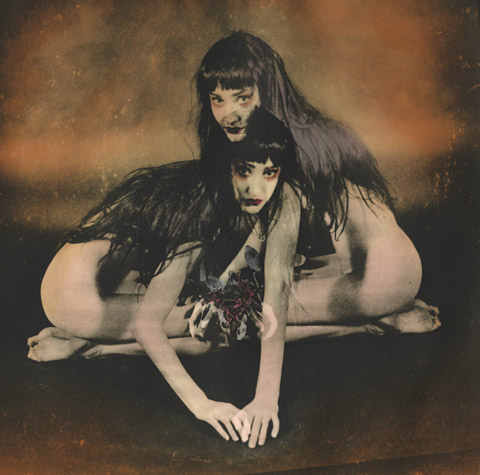
‘I will be making more films, certainly. I have something very dear to my heart that I wish to work on with a very special muse. Film is something very difficult for me so its challenge draws me closer every day.
‘I also have a hugely exciting and ambitious project coming soon with Prizme. He will be taking a leading role and I will be his director as it were. I think it will be on kickstarter at the end of the year.’
Total Pageviews
 views •
∞
views •
∞
Contact
Born in the mid-80s, Erin Herøin is a marveller of non-sequitur writing, cinematic films, & analogue photography.
Before, she used to be an aspiring physician; now, she is a newbie bassist who has 5.50/5.00 eyes & black tattoos on her right arm.
She's the former chief editor of Lomography's international magazine, the founder of Whilst We Wait, & the author of Paranoirexia.
Today, she curates and directs Parallel Planets, an online publication on creatives worldwide.
She dwells in the Eastern border of Manila with her pet pussies.
Before, she used to be an aspiring physician; now, she is a newbie bassist who has 5.50/5.00 eyes & black tattoos on her right arm.
She's the former chief editor of Lomography's international magazine, the founder of Whilst We Wait, & the author of Paranoirexia.
Today, she curates and directs Parallel Planets, an online publication on creatives worldwide.
She dwells in the Eastern border of Manila with her pet pussies.


